 Canada
  United Kingdom
  United States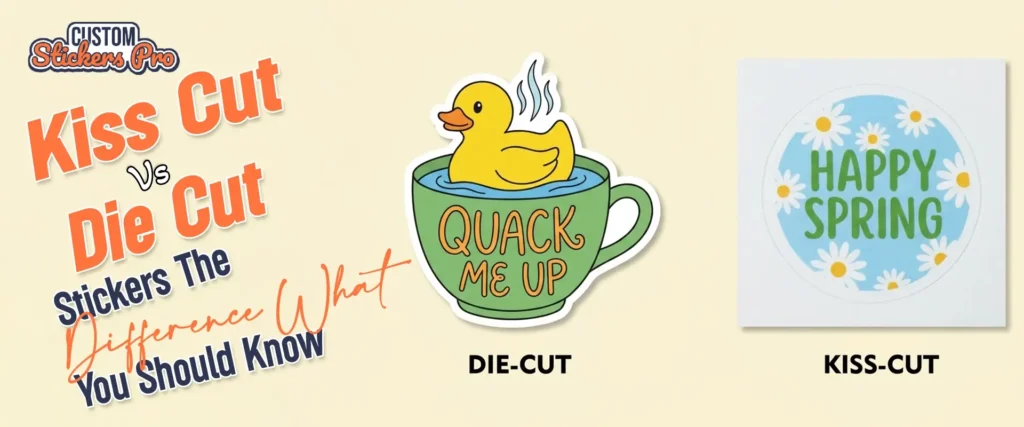
Imagine you’re ordering stickers. The site asks: kiss cut or die cut? No explanation. No picture. Just a dropdown menu. Most people guess. They pick whatever sounds fancier. That’s risky when you’re paying for a print run. Here’s the truth. Both terms just describe how the sticker gets cut after printing. That’s it. But this one small detail changes a lot. It affects how the sticker looks. Affects how it peels off. It affects how well it survives outside in the sun and rain.
Pick the wrong one and two things can happen. You might pay extra for a finish you didn’t need. Or your custom stickers might look unfinished and cheap. Most blogs online just repeat the same short explanation and stop there. They don’t tell you what happens on the actual production floor. This guide is different. You’ll learn the real difference between the two. And you’ll know exactly which cut fits your project by the end.
What Is Die Cut
Die cutting means the sticker gets cut all the way through. Both layers. The printed vinyl on top. The backing paper underneath. Both get sliced into the exact shape of your design. Nothing extra stays behind. No leftover border. No blank space around the edges. What you see is exactly what you peel off. Picture a laptop sticker shaped like a mountain. The edge follows the mountain’s outline perfectly. There’s no rectangle around it. No white background. No random shape holding it together. That clean edge is the whole point of die cutting.
A custom-shaped blade does this work. It’s called a “die.” The machine presses it through the material with precision. Tricky designs need extra care. Sharp points. Thin lines. Tight curves. All of these slow the process down, because the blade has to move carefully to avoid tearing anything. Die cut stickers are the go-to choice when a sticker needs to stand on its own. It should look finished. Not like it’s printed on a scrap of leftover paper.
What Is Kiss Cut
Kiss cutting only cuts through the top layer. That’s the printed vinyl or paper. The backing sheet underneath stays whole. Nothing separates it. This is why kiss cut stickers often sit inside a small square or rectangle. You have to peel that away first. Then you reach the actual design underneath. Think of a sticker sheet with eight small designs on it. Each design gets its own cut. But the whole sheet stays in one piece. It stays together until someone actually peels a sticker off. That’s kiss cutting in action.
The name makes sense once you know why. The blade barely touches the backing layer. It “kisses” it instead of slicing all the way through. This makes production faster. It’s also more forgiving, especially when a design doesn’t need a perfectly sharp outline. Custom Kiss cut stickers work best for sticker sheets. It also works well for labels. Anything meant to be peeled off a shared backing, one at a time, fits this style.
Kiss Cut and Die Cut Key Differences Explained
Let’s break it down first. The blade depth is what separates these two. Die cut goes through both layers, the sticker and the backing paper. The kiss cut only goes through the top layer. That’s it. That one detail changes the price you pay. It changes how long production takes. Changes how the stickers ship. It even changes how the final clear sticker looks once it’s peeled off the sheet. We’ve printed both types for years, and the difference always comes down to this one cut.
Die cut stickers:
- Cut through both the sticker and backing paper
- Follow the exact shape of your design
- Take longer to produce with detailed shapes
- Usually cost more per piece
- Often need extra packaging during shipping
Kiss cut stickers:
- Only the top layer gets cut
- Backing sheet stays in one piece
- Faster and simpler to produce
- Usually cheaper, especially in sheets
- Ship flat with no extra packaging needed
Where Each Cut Type Actually Works Best
Die cut works best when a sticker needs to stand on its own. A logo on a laptop is a good example. So is a character sticker on a water bottle. The cut follows the design’s outline exactly. No extra shape around it. No leftover edge. It just looks finished. There’s a practical reason too. Curved surfaces like bottles or helmets are easier to stick a die cut sticker on. Less flat backing gets in the way. That’s why most standalone merch uses die cut, not kiss cut.
Kiss cuts are different. It’s built for sheets, not single pieces. Think product labels. Think sticker packs with multiple designs. The backing stays in one piece, so people can peel stickers off one at a time, whenever they want. Production is quicker too. The blade only cuts the top layer, so it moves faster and costs less on bigger orders.
Cost works in opposite directions for each type. Die cut gets pricier as your design gets more detailed. Thin lines and sharp points need slow, careful cutting. Kiss cuts stay cheap even with several designs on one sheet. The tradeoff is a small visible border around each sticker until someone peels it off.
Pick die cut if:
- It’s a standalone sticker, not part of a set
- It’s going on a curved surface like a bottle or helmet
- The design has bold, simple shapes
- A slightly higher price per piece is fine
Pick kiss cut if:
- You’re making a sheet or set of stickers
- People will peel them off one at a time
- You want faster production and lower cost per piece
- A small border around each design isn’t a dealbreaker
Final Thoughts
There’s no universal winner between kiss cut and die cut. It just comes down to the job at hand. Do you need one sticker that looks complete by itself? Go with the die cut. The clean edge does the work for you. No background shape. No leftover border. Just the design, exactly as you made it.
Want a sheet of stickers people can peel off one at a time? Go with a CustomStickerspro. It’s faster to produce, cheaper at scale, and ships flat without extra hassle. A small border around each sticker isn’t a flaw here. It’s just part of how the format works.
Don’t pick based on what sounds more “premium.” Think about how the sticker will actually be used. Is it standalone or part of a set? Flat surface or curved one? Answer that first, and the right cut type becomes obvious.